Short answer: “Ladies of the Ton” referred specifically to the women of England’s highest social circle during the Regency period — peeresses, daughters of the higher peerage, wives and daughters of the wealthier gentry, and a small number of women admitted on the basis of marriage, fortune, or royal favour. The term was not a casual description of well-dressed women. It identified roughly 300 to 400 families’ worth of women who held the social capital to attend Almack’s, to be received at court, and to participate in the rituals of the London Season.
The phrase carried weight because membership in the Ton was conferred on women, not earned by them. A lady belonged to the Ton because her family belonged. Her marriage, her debut, her invitations, and her acquaintances were governed by a set of rules that operated almost entirely outside her own decisions.
Where the term comes from
The English borrowed le bon ton from French in the eighteenth century. Ton alone, in the French of the period, meant tone or manner — specifically the right tone, the fashionable manner. By the 1780s the phrase had been shortened in English usage to “the Ton” and applied to the people who set the social standard rather than to the standard itself.
A “lady of the Ton” was therefore not simply a fashionable woman. She was a woman recognised by the rest of the Ton as belonging to it. The recognition came through specific markers: presentation at court, attendance at Almack’s, inclusion in the visiting books of the great hostesses, and the right to be listed in publications such as La Belle Assemblée and The Lady’s Magazine when those journals reported on society events.
Who qualified
Membership was layered. The closer to the centre, the fewer the women.
Peeresses. The wives and widows of dukes, marquesses, earls, viscounts, and barons formed the inner ring. A duchess outranked a marchioness, who outranked a countess, and so on down the order of precedence. There were never more than a few hundred peeresses in England at any time during the Regency.
Daughters of peers. The daughters of peers held courtesy titles. The daughter of a duke or marquess was styled “Lady” followed by her Christian name and surname — Lady Caroline Lamb, Lady Sarah Spencer. The daughter of an earl held the same style. Daughters of viscounts and barons were styled “The Honourable.”
Wives and daughters of the higher gentry. Below the peerage sat the gentry: baronets, knights, and untitled landowning families of long standing. The wealthier and more anciently established among them — families like the Lambtons, the Pembertons, or the Egertons of Tatton — were accepted as part of the Ton even without a title, provided their estates and connections were substantial.
Heiresses. A woman who stood to inherit a significant fortune could be accepted into the Ton even if her family lacked a title or long social standing, provided she had no industrial taint and her family had been gentrified for at least a generation. The “heiress hunt” — the pursuit of well-dowered young women by titled but cash-poor suitors — was a recognised feature of every London Season.
Wives of public men. A small number of women entered the Ton by marriage to politicians, senior military officers, or diplomats. Lady Castlereagh, wife of the Foreign Secretary, was one of the most powerful women in London despite having been born Amelia Hobart, daughter of an earl but not of the inner aristocratic circle.
Who controlled the gateways
The Ton was governed less by men than by women. The most influential of these were the patronesses of Almack’s Assembly Rooms, a group of six or seven women who decided each week whether to grant vouchers admitting young ladies to the Wednesday balls in King Street. Without an Almack’s voucher, a young woman’s social existence was severely curtailed.
The patronesses during the Regency proper included Lady Jersey (Sarah Fane, Countess of Jersey), Lady Castlereagh, Princess Lieven (wife of the Russian ambassador), Countess Lieven, Lady Sefton, Lady Cowper, and Mrs Drummond Burrell. They met privately, discussed which families to admit and which to refuse, and issued vouchers accordingly. Their decisions could end a young woman’s marriage prospects before they had begun.
Beyond Almack’s, a smaller group of great hostesses controlled the dinner-party and ball circuit. Lady Holland at Holland House, the Duchess of Devonshire at Devonshire House, and Lady Melbourne in her London drawing rooms shaped which young women were seen, introduced, and remembered.
What “lady of the Ton” did not mean
The term was not a synonym for any of the following:
- A well-dressed woman. Fashion was necessary but not sufficient. Cit’s wives — the wives of City of London merchants — could afford the same dressmakers as countesses, but were not received in Mayfair drawing rooms.
- A wealthy woman. Wealth alone did not buy admission. The newly rich from industry or trade were excluded as a matter of course during the Regency itself, though their daughters and granddaughters often gained entry by marriage in later generations.
- An educated woman. Bluestockings — women known for their learning — were respected but often held at the edge of the Ton rather than at its centre. A reputation for excessive cleverness could damage a young woman’s marriage prospects.
- A virtuous woman. The Ton tolerated, and sometimes celebrated, women whose private lives were openly irregular, provided they retained the protection of family, title, and fortune. Lady Caroline Lamb’s affair with Byron in 1812 was a public scandal, but she remained a lady of the Ton because she remained Lady Caroline Lamb.
How a lady entered the Ton
A young woman’s formal entry into the Ton followed a recognised sequence.
- Presentation at court. Between the ages of sixteen and eighteen, she was presented to the Queen at one of the Drawing Rooms held at St James’s Palace. The dress code was rigid: a court gown with hoops, a long train, three ostrich plumes in the hair, and a deep curtsy.
- Almack’s. Once presented, she could be proposed for a voucher to Almack’s. Approval allowed her to attend the Wednesday balls during the Season.
- The Season. From late April through July, she attended balls, routs, breakfasts, theatre evenings, and morning visits in a structured weekly schedule. Her mother or a chaperone accompanied her at all public engagements.
- Marriage. The Season’s underlying purpose, for unmarried young women, was the contracting of a suitable match. Most ladies of the Ton married within three Seasons of their debut. A woman still unmarried after her third Season was beginning to be called on the shelf, though many later marriages were made and many women remained unmarried by choice or circumstance.
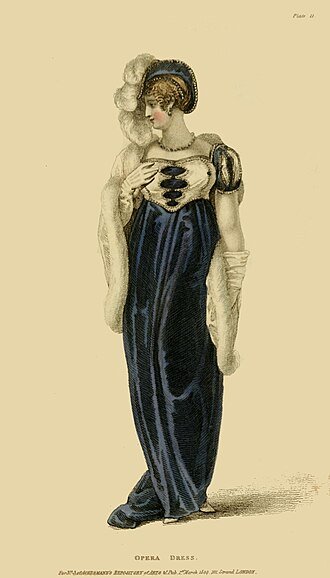
What the daily life of a lady of the Ton looked like
The hours were inverted from modern expectations. A lady of the Ton rose late, often after eleven. The morning was occupied with letters, dressmakers, and the receiving of morning calls, which by convention were paid in the afternoon. Dinner was served between five and seven in the country and as late as eight or nine in town. Evening engagements — balls, the opera, private parties — ran until two or three in the morning.
Her movement was rarely unaccompanied. A lady of the Ton walked in the park with a friend or family member, rode out with a groom, and drove out with a coachman and a footman. She did not enter public places alone. The reputation she built in her first Season followed her for the rest of her life.
Further reading on regencysociety.co.uk
- The Ton: Regency England’s Most Exclusive Social Circle
- Courtship, Marriage & Etiquette: The Delicate Dance of Regency England
- Regency Fashion & Attire: The Elegant Language of Regency England
FAQ
What does “ladies of the Ton” mean? The phrase refers specifically to the women of England’s highest social circle during the late Georgian and Regency periods — peeresses, daughters of the higher peerage, wives and daughters of the wealthier gentry, and a small number of women admitted by marriage, fortune, or royal favour.
Were all noblewomen ladies of the Ton? Most were, but not all. A peeress who lived permanently in the country, refused to take part in the London Season, or had retired from society after a scandal might be a noblewoman without functioning as a lady of the Ton in practice.
Could a commoner become a lady of the Ton? Rarely. A woman without a titled or gentry background could enter the Ton by marriage to a member, by inheriting a substantial fortune, or by attracting royal favour, but such cases were exceptions.
What role did Almack’s play for ladies of the Ton? Almack’s Assembly Rooms in King Street, St James’s, were the central gathering point for the marriageable young women of the Ton during the Season. The patronesses controlled admission by issuing vouchers, and exclusion from Almack’s was a serious blow to a young woman’s social standing.
How was a lady of the Ton addressed? By her style and title. A duke’s daughter was addressed as “Lady” followed by her Christian name. A peer’s wife was addressed as “Lady” followed by her husband’s title. A baronet’s wife was “Lady” followed by his surname. The rules of address were precise and observed strictly.